

What Are Marine Support Services in Offshore Oil and Gas?
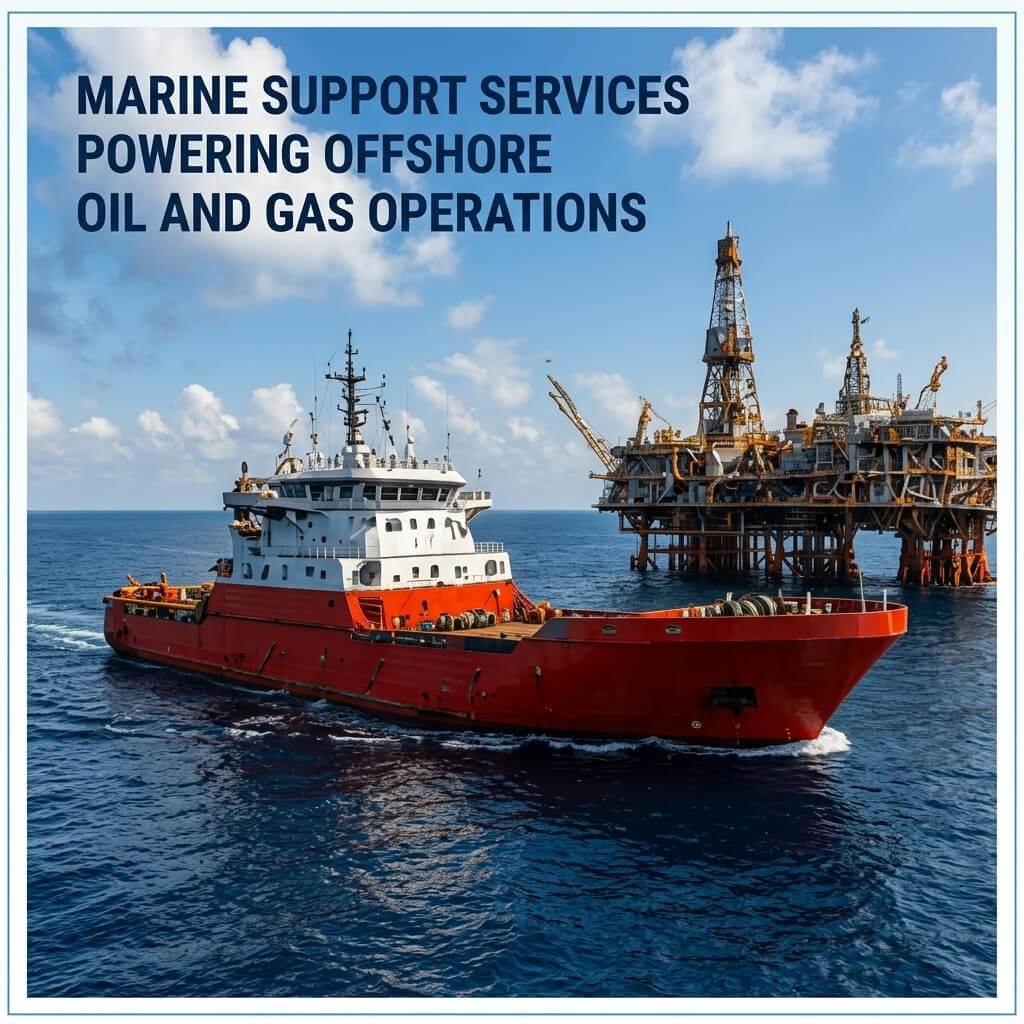
Marine support services are the offshore logistics, vessel operations, safety, technical, and emergency support activities that keep offshore oil and gas projects running efficiently. In simple terms, they are the backbone of offshore operations. Without marine support services, offshore rigs, platforms, FPSOs, subsea assets, and drilling campaigns cannot function safely or consistently.
Offshore oil and gas is not only about drilling wells or producing crude oil. It also depends on vessels, crew transfer, fuel supply, cargo movement, emergency response, security, maintenance support, waste handling, and regulatory compliance.
In Nigeria, offshore operations sit within a regulated environment involving agencies such as the Nigerian Upstream Petroleum Regulatory Commission, which oversees upstream petroleum activities, and NIMASA, which regulates and oversees maritime activities in Nigerian waters. NUPRC also operates systems such as the Oil and Gas Industry Service Permit portal and Offshore Safety Permit framework for personnel working in oil and gas locations.
This article explains what marine support services are, the different types, why they are critical in offshore oil and gas, and what Nigerian companies should consider when choosing a reliable marine support partner.
What Are Marine Support Services?
Marine support services refer to the specialized maritime operations that support offshore oil and gas exploration, drilling, production, maintenance, construction, and decommissioning. These services are delivered through vessels, marine personnel, offshore logistics teams, safety experts, engineers, and technical contractors.
A drilling platform cannot operate in isolation. It needs food, water, fuel, drilling materials, replacement parts, chemicals, tools, technical personnel, safety equipment, and emergency backup. All these must move across water, often under strict safety procedures and weather-sensitive conditions. Marine support services make that possible.
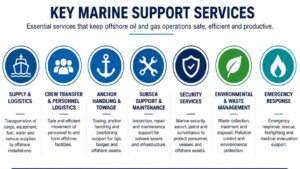
In offshore oil and gas, marine support services usually include:
- Offshore supply vessel operations
- Crew transfer and personnel logistics
- Anchor handling and towage
- Platform supply and cargo delivery
- Offshore construction support
- Subsea inspection and maintenance support
- Emergency response and rescue services
- Security escort and patrol services
- Pollution control and waste evacuation
- Bunkering, fuel, and freshwater supply
- Marine coordination and vessel management
The goal is simple: keep offshore operations safe, supplied, compliant, and productive.
Why Marine Support Services Matter in Offshore Oil and Gas
Offshore oil and gas projects are expensive, complex, and high-risk. Every hour of downtime can lead to major financial losses. If a rig does not receive critical equipment on time, drilling may stop. If personnel transfer is poorly managed, safety risks increase. If emergency response systems are weak, lives and assets can be exposed to avoidable danger.
Marine support services help offshore operators achieve five major objectives: operational continuity, safety, logistics efficiency, asset protection, and regulatory compliance.
For Nigeria, the importance is even stronger because offshore assets contribute significantly to national energy production, export revenue, local employment, and service-company opportunities. Recent deepwater investment activity also shows that offshore production remains strategically important to Nigeria’s oil and gas future. For example, ExxonMobil announced plans in 2025 to invest in deepwater operations around the Usan field, while Nigeria’s regulator has continued to support upstream development and production growth.
Key Types of Marine Support Services
1. Offshore Supply Vessel Services
Offshore Supply Vessels, often called OSVs or Platform Supply Vessels, transport essential cargo from shore bases to offshore installations. They carry drilling equipment, pipes, chemicals, spare parts, food, water, fuel, and other operational supplies.
In Nigeria, these vessels commonly operate between marine bases, jetties, terminals, offshore rigs, FPSOs, and production platforms. Their work must be timely because offshore facilities usually have limited storage space. A reliable supply vessel helps prevent shutdowns caused by delayed materials.
A good offshore supply vessel operation requires proper cargo planning, certified lifting equipment, trained deck crew, safety checks, weather monitoring, and clear communication between the shore base and offshore installation.
2. Crew Transfer and Personnel Logistics
Offshore projects depend on people: engineers, technicians, safety officers, divers, rig workers, inspectors, security personnel, and marine crew. Marine support services handle the safe movement of these workers to and from offshore locations.
Crew transfer may involve crew boats, security escort boats, helicopters, or a combination of marine and air logistics. In Nigerian offshore environments, personnel movement must be properly documented and aligned with safety requirements. NUPRC’s Offshore Safety Permit is designed as a personnel accountability system for tracking people working in onshore and offshore oil and gas locations. It also supports emergency response, training verification, medical readiness, and worker accountability.
This makes personnel logistics more than transportation. It is a safety-critical service.
3. Anchor Handling and Towage
Anchor Handling Tug Supply vessels, known as AHTS vessels, support drilling rigs, barges, and offshore units that need positioning or relocation. These vessels handle anchors, tow floating equipment, and assist with station-keeping.
This service is important during rig moves, field development, pipe-lay operations, and offshore construction. Anchor handling is technically demanding because it involves heavy equipment, high-tension lines, weather risk, and precise marine coordination.
Poor anchor handling can damage subsea infrastructure, delay operations, or create safety incidents. That is why experienced vessel masters, marine engineers, deck officers, and project coordinators are essential.
4. Offshore Construction Support
Offshore oil and gas development requires installation, repair, and modification of marine infrastructure. Construction support services assist with the building and maintenance of platforms, subsea structures, pipelines, risers, mooring systems, and floating production units.
Marine support vessels may provide accommodation, crane support, diving support, pipe transportation, equipment positioning, and project logistics. These operations often require close coordination with engineering, procurement, and construction teams.
In Nigeria, offshore construction support is relevant for field development projects, brownfield upgrades, FPSO operations, terminal maintenance, and subsea intervention campaigns.
5. Subsea Inspection, Repair, and Maintenance Support
Many offshore oil and gas assets are located below the water surface. These include pipelines, wellheads, manifolds, risers, mooring lines, and subsea control systems. Marine support services provide the vessels and equipment needed to inspect, maintain, and repair these assets.
Subsea support may involve Remotely Operated Vehicles, divers, sonar equipment, survey tools, and specialized inspection teams. The goal is to detect corrosion, leaks, structural damage, seabed movement, or mechanical faults before they become major failures.
For oil and gas operators, subsea inspection is not optional. It protects production, prevents environmental incidents, and extends asset life.
6. Emergency Response and Rescue Services
Offshore work carries real risk. Fire, medical emergencies, vessel collision, man-overboard incidents, equipment failure, security threats, and severe weather can happen at sea. Marine support services provide emergency response vessels, standby rescue vessels, medical evacuation support, firefighting capacity, and search-and-rescue coordination.
A strong emergency response system can save lives and reduce asset damage. It also supports compliance with offshore safety expectations and international best practices.
For Nigerian offshore operations, emergency preparedness is particularly important because some offshore locations are far from immediate shore-based help. Response time, vessel readiness, trained crew, communication systems, and emergency drills must be taken seriously.
7. Marine Security Support
Security is a major concern in some West African offshore and coastal environments. Marine security support may include patrol boats, escort vessels, surveillance, access control, risk assessment, and coordination with approved security agencies.
Security support helps protect personnel, vessels, cargo, offshore assets, and critical petroleum infrastructure. It is especially relevant for crew transfer, supply operations, nearshore movement, terminal operations, and high-value equipment transport.
A professional marine support company should understand both maritime security risk and Nigerian regulatory expectations. Security must be handled legally, professionally, and without disrupting legitimate maritime activity.
8. Waste Management and Environmental Support
Offshore oil and gas operations produce waste: used oil, drilling waste, domestic waste, packaging materials, contaminated water, scrap, and other operational by-products. Marine support services help evacuate, transport, and manage waste safely.
Environmental support may also include spill response, pollution control, containment equipment, waste reception coordination, and environmental monitoring support. NIMASA lists offshore waste reception facilities among its useful maritime resources, while the agency’s wider mandate includes maritime regulation and safety in Nigerian waters.
Effective waste management protects the marine environment, reduces legal exposure, and supports corporate responsibility.
9. Bunkering, Fuel, and Freshwater Supply
Offshore vessels, rigs, and platforms need fuel and freshwater. Marine support companies may provide bunkering services, diesel delivery, lubricants, potable water, and other consumables required for continuous operations.
This service must be handled with strict safety and quality controls. Fuel contamination, poor transfer procedures, or inaccurate documentation can create operational and financial problems.
For Nigerian oil and gas operators, dependable supply capacity is important because offshore projects often run on tight schedules. A delay in fuel or freshwater supply can affect vessel movement, power generation, drilling activity, and crew welfare.
Common Vessels Used in Marine Support Services
Marine support services depend on different vessel types. Each vessel has a specific function.
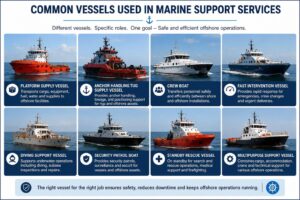
Platform Supply Vessels carry cargo, fuel, water, drilling materials, and equipment to offshore platforms and rigs. Anchor Handling Tug Supply vessels handle towing and anchor work. Crew boats move personnel between shore and offshore locations. Fast intervention vessels support urgent technical or safety tasks. Security patrol boats provide escort and surveillance. Diving Support Vessels support underwater inspection, repair, and maintenance. Multipurpose support vessels combine cargo, accommodation, crane, and technical support roles.
Choosing the right vessel matters. A vessel that is too small may not handle the sea state or cargo load. A vessel that is poorly equipped may fail safety inspection. A vessel without competent crew can increase operational risk.
How Marine Support Services Work in Practice
A typical marine support operation begins with planning. The client identifies what must be moved, who must be transferred, the destination, timing, safety requirements, and documentation. The marine support provider then assigns suitable vessels, crew, equipment, permits, and operational procedures.
Before sailing, the team checks the cargo manifest, vessel readiness, weather, fuel, communication systems, safety equipment, security risk, and emergency plans. During transit, the vessel maintains communication with the shore base, marine coordinator, and offshore installation. At the offshore site, cargo may be transferred using cranes, baskets, hoses, or other approved methods.
After completion, documentation is updated. This may include delivery notes, voyage reports, fuel records, safety observations, incident reports, and client sign-off.
The best marine support companies do not only provide vessels. They provide planning, coordination, compliance, and accountability.
Marine Support Services and Nigerian Compliance
In Nigeria, marine support services operate within both petroleum and maritime regulatory frameworks. Offshore oil and gas contractors may need relevant permits, safety documentation, vessel certificates, crew documentation, insurance, and client-specific approvals.
NUPRC provides guidelines and regulatory systems for upstream oil and gas operations, including service permits through the Oil and Gas Industry Service Permit portal. NIMASA regulates and oversees maritime activities in Nigerian waters, including safety, capacity development, and industry promotion.
For companies offering marine support services, compliance is not paperwork alone. It is part of operational credibility. Clients need assurance that vessels are seaworthy, crews are competent, workers are documented, and operations meet safety standards.
Challenges Facing Marine Support Services in Nigeria
Marine support services in Nigeria face several operational challenges.
The first is cost. Offshore vessels are expensive to acquire, maintain, crew, insure, and operate. Fuel, spare parts, dry docking, port charges, and compliance costs can be high.
The second is infrastructure. Marine bases, jetties, storage areas, repair yards, and logistics facilities must be efficient enough to support offshore timelines.
The third is safety and security. Offshore operations need reliable emergency response, trained personnel, and strong risk controls.
The fourth is weather and sea conditions. Rough seas, storms, visibility problems, and seasonal changes can affect vessel schedules.
The fifth is documentation and compliance. Operators must manage permits, certificates, inspections, and reporting requirements carefully.
Despite these challenges, the sector remains essential because offshore oil and gas cannot function without marine logistics and technical support.
How to Choose a Marine Support Services Company
For oil and gas operators, selecting the right marine support partner requires more than comparing prices. The lowest quote may not provide the best value if the company lacks certified vessels, trained crew, safety systems, or operational discipline.
A reliable marine support company should have:
- Suitable vessels for the project scope
- Strong safety management systems
- Experienced marine crew and project personnel
- Valid regulatory permits and documentation
- Emergency response capability
- Transparent reporting and communication
- Knowledge of Nigerian offshore terrain
- Ability to deliver on schedule
- Environmental responsibility
- Proven experience with oil and gas clients
The best provider should understand that offshore support is mission-critical. Every voyage, transfer, delivery, and emergency plan affects the larger project.
The Future of Marine Support Services in Nigeria
The future of marine support services in Nigeria will be shaped by offshore investment, local content development, technology, safety expectations, and energy transition pressures. As offshore fields mature, there will be more demand for inspection, maintenance, repair, decommissioning support, subsea services, and environmental management.
At the same time, new offshore projects will require modern vessels, digital tracking, better fuel efficiency, trained Nigerian seafarers, and stronger compliance systems. NIMASA’s focus on maritime capacity development and industry promotion also aligns with the need for stronger local participation in marine services.
For Nigerian businesses, this creates opportunities in vessel ownership, marine logistics, technical manpower, marine engineering, safety training, environmental services, offshore catering, equipment leasing, and project support.
Marine support services are not secondary activities in offshore oil and gas. They are central to safe, efficient, and profitable offshore operations. From moving crew and equipment to supporting emergency response, offshore construction, subsea inspection, marine security, and environmental protection, these services keep offshore projects alive.
For Nigerian oil and gas operators, choosing the right marine support services provider can improve safety, reduce downtime, protect assets, and strengthen compliance. In a sector where delays are costly and risks are high, dependable marine support is not optional. It is a strategic requirement